
English to Tagalog Dictionary Apk Download Now For Philippines
How to install English to Tagalog Dictionary Apk Download Now For Philippines APK?
1. Tap the downloaded English to Tagalog Dictionary Apk Download Now For Philippines APK file.
2. Touch install.
3. Follow the steps on the screen.
| Updated | September 2026 |
| Size | 34.3Mb |
| Version | v11.4.0 |
| Requirements | Android 6.0+ |
| Downloads | 277300+ |
Description
An English to Tagalog dictionary is a useful resource for anyone who wants to understand, translate, or learn Tagalog words and expressions from English. Whether you are a student, traveler, language learner, teacher, or simply communicating with Filipino speakers, a reliable dictionary can make it easier to find the right word and understand how it is used.
Tagalog is an Austronesian language spoken primarily in the Philippines and serves as the foundation of Filipino, the country’s national language. English and Filipino are both official languages of the Philippines, making English-to-Tagalog translation especially useful for education, business, travel, communication, and everyday life.
What Is an English to Tagalog Dictionary?
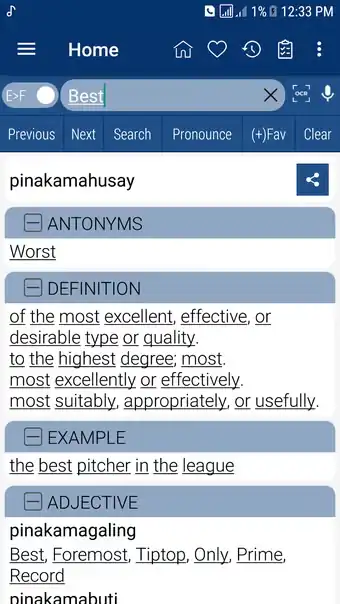
An English to Tagalog dictionary provides the Tagalog equivalent of English words, phrases, and expressions. Depending on the dictionary, an entry may also include definitions, pronunciation, parts of speech, synonyms, example sentences, and additional notes about usage.
For example:
| English | Tagalog |
|---|---|
| Love | Pag-ibig / Mahal |
| Happy | Masaya |
| Family | Pamilya |
| Friend | Kaibigan |
| Food | Pagkain |
| Home | Tahanan / Bahay |
| Beautiful | Maganda |
| Thank you | Salamat |
| Good morning | Magandang umaga |
| Help | Tulong |
However, translation is not always a simple matter of replacing one word with another. The correct Tagalog translation can change depending on the context, grammar, and intended meaning.
Why Use an English to Tagalog Dictionary?
A dictionary can be much more useful than a basic word-for-word translator because it can provide information about how a word actually works in a sentence. Make sure to download it from a reliable source.
1. Learn Accurate Word Meanings
Many English words have multiple meanings. A good dictionary helps identify the appropriate Tagalog equivalent according to the context.
For example, the English word “light” can refer to illumination, something that is not heavy, or the act of igniting something. Each meaning may require a different translation.
This is why context is essential when translating between English and Tagalog.
2. Improve Your Tagalog Vocabulary
Regularly using an English-to-Tagalog dictionary can help learners gradually expand their vocabulary. Instead of memorizing isolated words, learners can study words together with their meanings, pronunciation, and examples.
Some dictionaries also provide related words, synonyms, and common expressions, allowing users to build vocabulary more efficiently.
3. Understand Words in Context
A translation can be technically correct but sound unnatural when used in the wrong situation.
For example:
English: “How are you?”
Tagalog: “Kumusta ka?”
English: “Thank you very much.”
Tagalog: “Maraming salamat.”
English: “What is your name?”
Tagalog: “Ano ang iyong pangalan?”
Seeing translations in complete sentences makes it easier to understand how Tagalog is naturally used.
4. Learn Pronunciation
Pronunciation is an important part of learning any language. Some English-to-Tagalog dictionaries provide pronunciation information alongside translations.
A comprehensive dictionary may also include parts of speech, common combinations of words, and pronunciation guidance. For example, the Tuttle Concise Tagalog Dictionary contains more than 20,000 entries and includes information about pronunciation, parts of speech, and common collocations.
English to Tagalog Translation vs. Dictionary
Although the terms are sometimes used interchangeably, an English-to-Tagalog translator and an English-to-Tagalog dictionary serve slightly different purposes.
A translator is generally designed to convert a sentence, paragraph, or larger piece of text from English into Tagalog.
A dictionary, on the other hand, is primarily designed to help users understand individual words and their possible meanings.
For example, if you want to translate:
“I am going to the market.”
a translator can provide a complete Tagalog sentence.
If you want to know what “market” means, a dictionary can provide the relevant Tagalog word along with definitions, pronunciation, and potentially example sentences.
For language learning, using both resources together can be especially helpful.
Common English to Tagalog Words
Learning frequently used vocabulary is a practical way to begin studying Tagalog.
| English Word | Tagalog Translation |
|---|---|
| I | Ako |
| You | Ikaw / Ka |
| He/She | Siya |
| We | Kami / Tayo |
| They | Sila |
| What | Ano |
| Where | Saan |
| When | Kailan |
| Who | Sino |
| Why | Bakit |
| How | Paano |
| Yes | Oo |
| No | Hindi |
| Good | Mabuti |
| Beautiful | Maganda |
| Big | Malaki |
| Small | Maliit |
| Eat | Kumain |
| Drink | Uminom |
| Go | Pumunta |
| Come | Pumunta / Dumating |
| See | Makita |
| Know | Malaman |
| Want | Gusto |
| Need | Kailangan |
These basic words form a useful starting point for learners who are developing everyday Tagalog vocabulary.
Common English to Tagalog Phrases
Knowing complete phrases can be more useful than memorizing individual words because language is normally used in sentences and conversations.
Here are several common examples:
Good morning → Magandang umaga
I’m fine. → Mabuti naman.
Good evening → Magandang gabi
How are you? → Kumusta ka?
Good afternoon → Magandang hapon
Thank you. → Salamat.
Thank you very much. → Maraming salamat.
You’re welcome. → Walang anuman.
Goodbye. → Paalam.
I love you. → Mahal kita.
I don’t understand. → Hindi ko maintindihan.
Please help me. → Pakitulungan mo ako.
These expressions are commonly useful for beginners who want to start communicating in Tagalog.
How to Use an English to Tagalog Dictionary Effectively?
Simply looking up individual words is helpful, but you can get much more value from a dictionary by using it as a learning tool.
Search for the Complete Meaning
When you find a Tagalog translation, look at the definition rather than immediately assuming it is the only possible translation.
An English word may have several Tagalog equivalents depending on the context.
Check Example Sentences
Example sentences show you how a word behaves in real communication. They can also help you understand grammar and word order.
Resources such as Glosbe provide translations together with definitions, grammar information, and examples of words and expressions used in context.
Pay Attention to Parts of Speech
Knowing whether a word is a noun, verb, adjective, or another part of speech can prevent translation mistakes.
For example, a dictionary entry may distinguish between a word used as a noun and a related form used as a verb.
Compare Multiple Meanings
Don’t automatically choose the first translation you see. Read the available meanings and determine which one matches your sentence.
This is particularly important for English words with broad or ambiguous meanings.
Why Context Matters in English to Tagalog Translation?
One of the biggest challenges in translation is that languages do not always organize meaning in exactly the same way.
A direct word-for-word translation may produce a sentence that is understandable but unnatural. In other cases, the same English word may require different Tagalog words depending on the situation.
For example, English expressions involving emotions, politeness, relationships, and everyday conversation often require attention to tone and context.
This is why a quality dictionary should ideally provide more than a single translated word. Definitions, usage examples, pronunciation, and grammatical information can help users choose the most appropriate translation.
English and Tagalog: Two Different Language Families
These both have different linguistic origins. English belongs to the Indo-European language family, while Tagalog belongs to the Austronesian language family.
Despite this difference, English has had a significant influence on language use in the Philippines. English and Filipino are both official languages, and English is widely used in education, government, business, media, and professional communication.
As a result, learners may encounter English-derived vocabulary alongside traditional Tagalog words.
Who Can Benefit from an English to Tagalog Dictionary?
An English-to-Tagalog dictionary can be useful for a wide range of people.
Students
Students can use dictionaries to understand unfamiliar Tagalog vocabulary, complete language assignments, and improve their reading and writing skills.
Travelers
Visitors to the Philippines can learn useful greetings, questions, directions, and everyday expressions before or during their trip.
English Speakers Learning Tagalog
A dictionary provides a convenient way to build vocabulary gradually and understand common expressions.
Filipino Speakers Learning English
Because many English-to-Tagalog dictionaries are bidirectional, Filipino speakers can also use them to learn English vocabulary and meanings. Some comprehensive dictionaries are specifically designed to support learning in both directions.
Writers and Translators
Writers and translators can use dictionaries as a reference when checking vocabulary, terminology, and possible meanings.
Choosing a Good English to Tagalog Dictionary
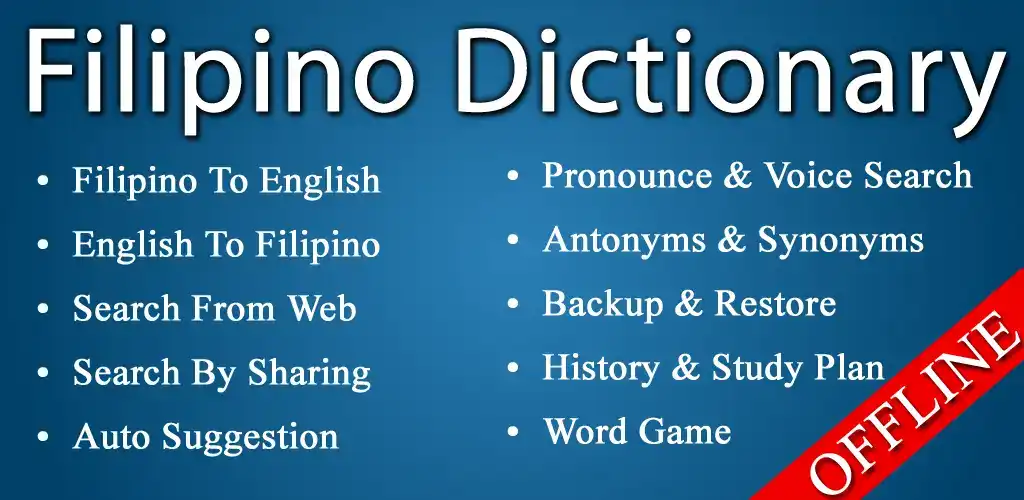
Not every dictionary or translation tool provides the same level of information. When choosing one, consider the following features:
- Accurate translations
- Clear definitions
- Example sentences
- Pronunciation guidance
- Parts of speech
- Synonyms and related words
- Common phrases and expressions
- English-to-Tagalog and Tagalog-to-English search
- Easy-to-use search functionality
- Regularly updated vocabulary
A resource that provides context and examples is generally more useful for serious language learning than one that simply displays a single translated word.
Online English to Tagalog Dictionaries
Online dictionaries have made language resources much easier to access. Users can search for a word from a phone, tablet, or computer without carrying a physical dictionary.
Modern online resources may include searchable databases, example sentences, pronunciation features, translation tools, and vocabulary-learning functions. Some platforms also allow users to move between English-to-Tagalog and Tagalog-to-English searches.
However, users should still review important translations carefully. Automated translation is useful for many everyday tasks, but context-sensitive or professional content may require verification by a fluent speaker or qualified translator.
Tips for Getting Better Translation Results
When using an online English-to-Tagalog translator, the quality of the original English can affect the result.
For better results:
- Use clear and complete sentences.
- Avoid unnecessary slang when accuracy is important.
- Check words with multiple meanings.
- Review the translated sentence for naturalness.
- Compare the translation with dictionary definitions.
- Use example sentences to confirm the intended meaning.
- Have important translations reviewed by a fluent Tagalog speaker.
For longer passages, translating smaller sections can also make it easier to identify and correct mistakes.
Frequently Asked Questions
What is an English to Tagalog dictionary?
An English-to-Tagalog dictionary is a reference tool that provides Tagalog translations and meanings for English words and expressions. Depending on the resource, it may also include pronunciation, examples, grammar information, and related words.
Is Tagalog the same as Filipino?
Tagalog and Filipino are closely related, but they are not simply interchangeable terms in every context. Filipino is the national language of the Philippines and is historically based largely on Tagalog while continuing to develop and incorporate vocabulary from other Philippine languages and sources.
Can I use an English to Tagalog dictionary for learning Tagalog?
Yes. A dictionary can be an excellent learning resource, particularly when you study definitions, example sentences, pronunciation, and related vocabulary rather than memorizing translations alone.
Is machine translation always accurate?
No. Automated translation can be helpful, particularly for common words and straightforward sentences, but context, idioms, tone, names, and specialized terminology can create challenges. Important translations should be reviewed when accuracy is critical.
Can I translate Tagalog back into English?
Yes. Many modern bilingual dictionaries and translation tools support both English-to-Tagalog and Tagalog-to-English searches.
Final Thoughts
An English to Tagalog dictionary is more than a simple list of translated words. It can be a valuable language-learning and communication resource that helps users understand vocabulary, pronunciation, grammar, context, and everyday expressions.
For beginners, starting with common words and phrases is an effective way to build confidence. As your vocabulary grows, studying example sentences and contextual meanings can help you move from memorizing individual translations to understanding how Tagalog is naturally used.
Whether you are learning Tagalog for travel, education, work, communication, or personal interest, a reliable English-to-Tagalog dictionary can provide a practical foundation for developing your language skills.